Building a marketplace is only the first step. For it to grow, its categories, listings, dealer profiles, articles and other public pages must be discoverable by the right audience.
Search engine optimization makes that discovery possible, but routine SEO work should not require a developer every time a business needs to improve a page title, rewrite a description or change how a link appears when shared online. CubiqWeb solves this with an SEO rules engine managed from the admin panel, allowing authorized teams to optimize marketplace pages without changing application code.
Why SEO Is More Complex for a Marketplace
A standard business website may contain only a few fixed pages. A marketplace can generate hundreds or thousands of pages, each targeting a different customer need or search intent.
- Category and subcategory browse pages
- Listing detail pages
- Dealer or seller profiles
- Location-based browse pages
- Articles and content pages
- Search and filtered result pages
- Other CMS-managed pages
Someone searching for a used car in Rajkot has a different intent from someone looking for a jewellery dealer, property listing or professional service. Reusing the same title and description everywhere makes it difficult for search engines and potential customers to understand what each page offers.
Manually coding SEO data for every page type is equally difficult to maintain. CubiqWeb makes the process scalable through centralized SEO rules based on page type, optional matching conditions, priority and reusable templates.
Manage SEO Directly From the Admin Panel
Authorized administrators can manage SEO without editing frontend templates, backend classes or database code. This lets business, content and marketing teams improve search presentation without waiting for another development and deployment cycle.
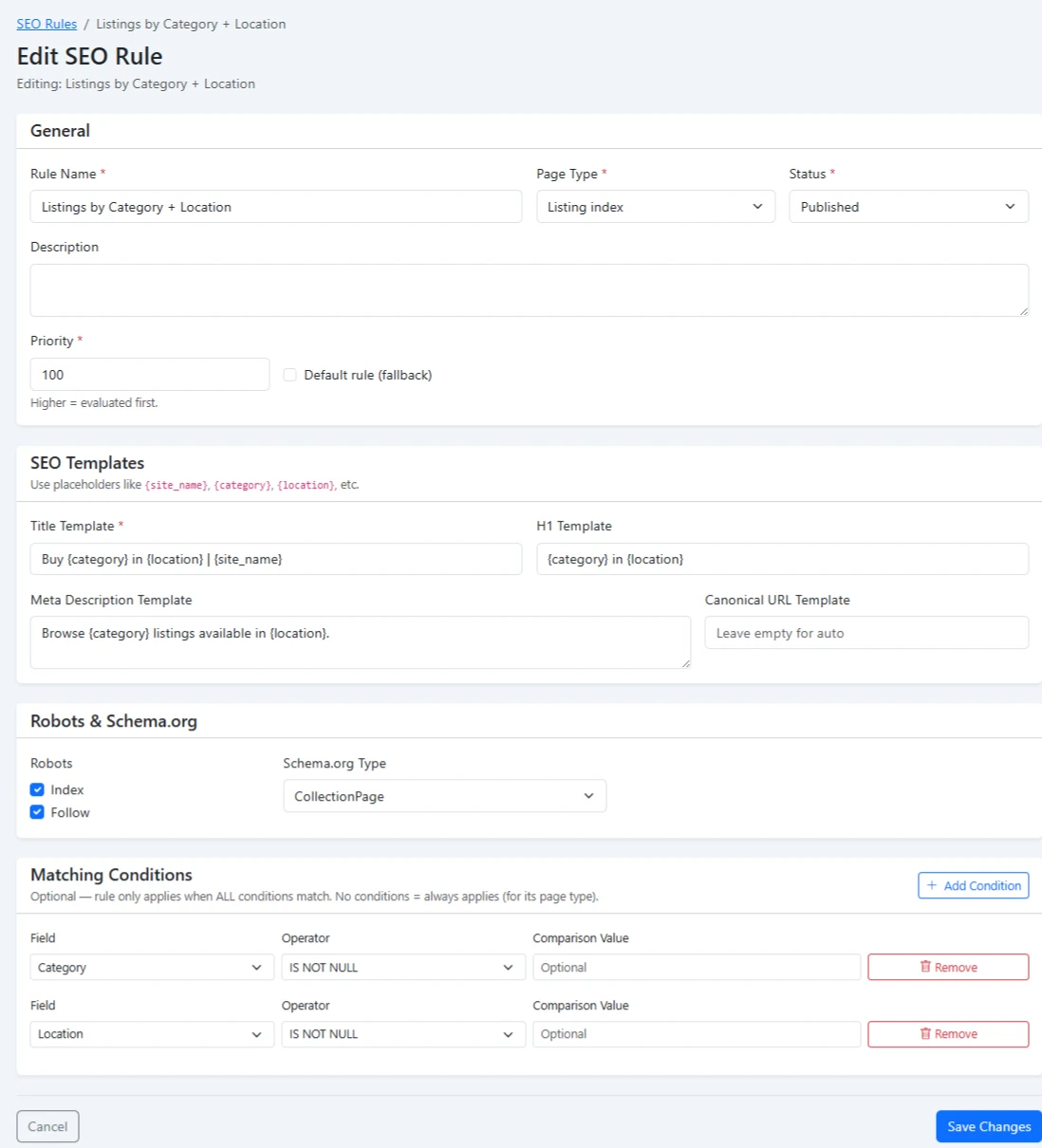
From the SEO Rules screens, teams can configure:
- SEO title templates with dynamic placeholders
- Meta description and H1 templates
- Canonical URL templates or automatic clean canonicals
- Index/noindex and follow/nofollow directives
- Optional Schema.org type configuration
- Matching conditions for focused page contexts
- Priority-based rules and reliable default fallbacks
- Localized template translations for enabled languages
How page-level control works
CubiqWeb does not require a separate meta form on every listing or category. High-priority rules with conditions can target important categories or locations, while lower-priority default rules cover the remaining pages. Listing titles, dealer names, article headlines and media still feed the final page through dynamic templates and built-in fallbacks.
Dynamic SEO Templates for Marketplace Pages
Writing SEO data separately for every listing would quickly become impractical. CubiqWeb instead supports reusable templates for important marketplace page types, including the home page, listing index and detail, dealer index and detail, article pages, article-type browse pages and connected CMS pages.
| Placeholder | Typical use |
|---|---|
{site_name} | Marketplace or brand name from site settings |
{site_tagline} | Site tagline |
{listing_title} | Listing headline |
{category} / {subcategory} | Relevant marketplace category labels |
{listing_type} | Sell, rent, hiring or another configured type |
{price} | Formatted price when available |
{location} | City, area or location shown on the page |
{dealer_name} / {industry} | Dealer identity and business type |
{article_title} / {article_type} | Article context |
{brand}, {model}, {year} | Listing attributes supplied by the page context |
For example, a listing title template can use:
{listing_title} for Sale in {location} | {site_name}
CubiqWeb replaces these placeholders when the page is generated. Every eligible page receives a more relevant title without someone writing it manually. If the business changes its SEO strategy, an administrator updates the central rule rather than modifying every affected page.
Focused Rules for Important Categories and Locations
Templates provide consistency across a large catalog. When a particular segment needs a sharper message, administrators can create a higher-priority rule with conditions that match its context. Lower-priority defaults continue to cover everything else.
Where focused rules help
- High-value categories
- Important cities and service areas
- Featured article or content types
- Competitive product or service segments
How rule selection works
- Match the page type and available context.
- Evaluate optional category, location or other conditions.
- Apply the highest-priority published rule.
- Use a safe built-in fallback when no rule matches.
Structured Data Helps Search Engines Understand Each Page
Search engines do not only read visible text. They also use structured data to understand what a page represents and how its entities relate to one another. CubiqWeb emits relevant Schema.org JSON-LD across public marketplace pages.
- Product, Offer and vertical listing types where supported by the catalog
- Organization and site identity on the home experience
- LocalBusiness for dealer profiles
- BreadcrumbList for navigation context
- ItemList for browse and collection pages
- Article for editorial content
- WebSite with search action where applicable
Live markup is driven by the page's real content and marketplace vertical so search engines receive an accurate entity graph. Eligible structured data may support enhanced search-result features, but their appearance is always determined by the search engine and cannot be guaranteed by any platform.
Canonical URLs and Indexing Control
Marketplaces commonly generate several URL variations through filters, sorting, pagination and browsing combinations. Without a clear policy, search engines may treat similar versions as competing pages.
CubiqWeb combines:
- Admin-controlled index/noindex and follow/nofollow flags
- Canonical URLs based on clean browse and detail paths
- Optional canonical templates on individual SEO rules
- Automatic noindex treatment for private account areas and keyword search results
- Environment safeguards that prevent non-production sites from being indexed
| SEO concern | CubiqWeb approach |
|---|---|
| Query-only browse variants | Prefer intentional category, type and location paths |
| Keyword search result pages | Keep them from competing with designed landing pages |
| Private user journeys | Exclude account, messaging and posting flows from indexing |
| Listing and dealer details | Use stable, self-canonical clean URLs |
SEO-Friendly URLs, Breadcrumbs and Content Structure
SEO is not limited to meta tags. Clear URLs, breadcrumbs and well-structured content help visitors and search engines understand the marketplace. CubiqWeb supports readable paths that can reflect language, category, listing type, location and listing slug instead of exposing only internal numeric identifiers.
Example clean URL structure
/en/vehicles/cars/for-sale/rajkot/example-listing-slug/
Combined with breadcrumb structured data and logical category relationships, these descriptive paths create a clearer journey for users and crawlers before the page is even opened.
Social Sharing and Link Previews
A marketplace page may be discovered through WhatsApp, Facebook, LinkedIn, X or another channel before it appears in a search result. CubiqWeb prepares Open Graph and Twitter Card tags using the resolved SEO title and description, along with the most relevant available page media.
Listing images, dealer logos, article images or site branding can provide the preview image. Administrators influence the final presentation by improving central SEO rules and maintaining strong primary media, without managing a separate social-only form for every page.
Sitemaps and Crawler Entry Points
Alongside page-level meta information and structured data, CubiqWeb can generate XML sitemap inventories for listing browse combinations, dealer browse paths and listing or dealer detail URLs. A robots entry point and sitemap index help crawlers discover the URLs the marketplace intends to promote.
Canonicals, noindex rules and sitemaps work together: canonicals identify the preferred version, indexing rules exclude unsuitable pages, and sitemaps reinforce the primary discovery inventory.
Designed for Multilingual and Location-Based Growth
Marketplaces often expand across languages, categories and geographic regions. CubiqWeb's template-based approach uses the live page context so titles and descriptions can include relevant category, listing and location information.
Multilingual SEO support includes:
- Locale-prefixed public URLs
hreflangalternates when multiple languages are enabled- Translated SEO templates through locale tabs in the admin panel
- Context-aware titles and descriptions for different markets
Faster SEO Improvements With Less Development Dependency
In a conventional marketplace, even a small SEO change may require a developer to update code, test it and deploy another version. Repeating that cycle for every title or description slows experimentation and makes ongoing optimization unnecessarily expensive.
| Conventional workflow | CubiqWeb SEO workflow |
|---|---|
| Request a code change | Edit an authorized rule in the admin panel |
| Repeat values page by page | Reuse dynamic templates across page types |
| Create one-off conditional logic | Use conditions and priorities for focused segments |
| Deploy routine content adjustments | Publish supported changes through the existing system |
| Risk missing metadata | Use safe defaults when no custom rule matches |
The practical benefits include:
- Faster updates to SEO titles and descriptions
- Consistent rules across dynamically generated pages
- Condition- and priority-based targeting without one-off code
- Less repetitive development work
- Easier testing of different search messages
- More control for marketing and content teams
- A scalable approach as listings, categories and locations increase
- Safe fallbacks when a custom rule is missing
SEO That Supports Better Customer Reach
CubiqWeb's SEO tool is not simply a collection of meta fields. Its purpose is to help each useful marketplace page communicate clearly with search engines, social platforms and potential customers.
A complete marketplace SEO foundation
SEO rankings cannot be guaranteed. Results also depend on content quality, competition, domain authority, performance and search-engine policies. CubiqWeb provides the control and technical structure required to optimize marketplace pages continuously without code changes for routine SEO work.
Build a Marketplace That Can Be Discovered
A powerful marketplace should not only manage listings and users; it should help customers discover the right products, services and businesses. CubiqWeb's SEO rules engine makes optimization manageable from the admin panel while keeping the underlying system flexible enough to grow with new categories, locations, languages, content and business goals.
Explore CubiqWeb Marketplace
See how CubiqWeb combines flexible marketplace management with SEO tools built for sustainable growth.